Our Socials
Linkedin
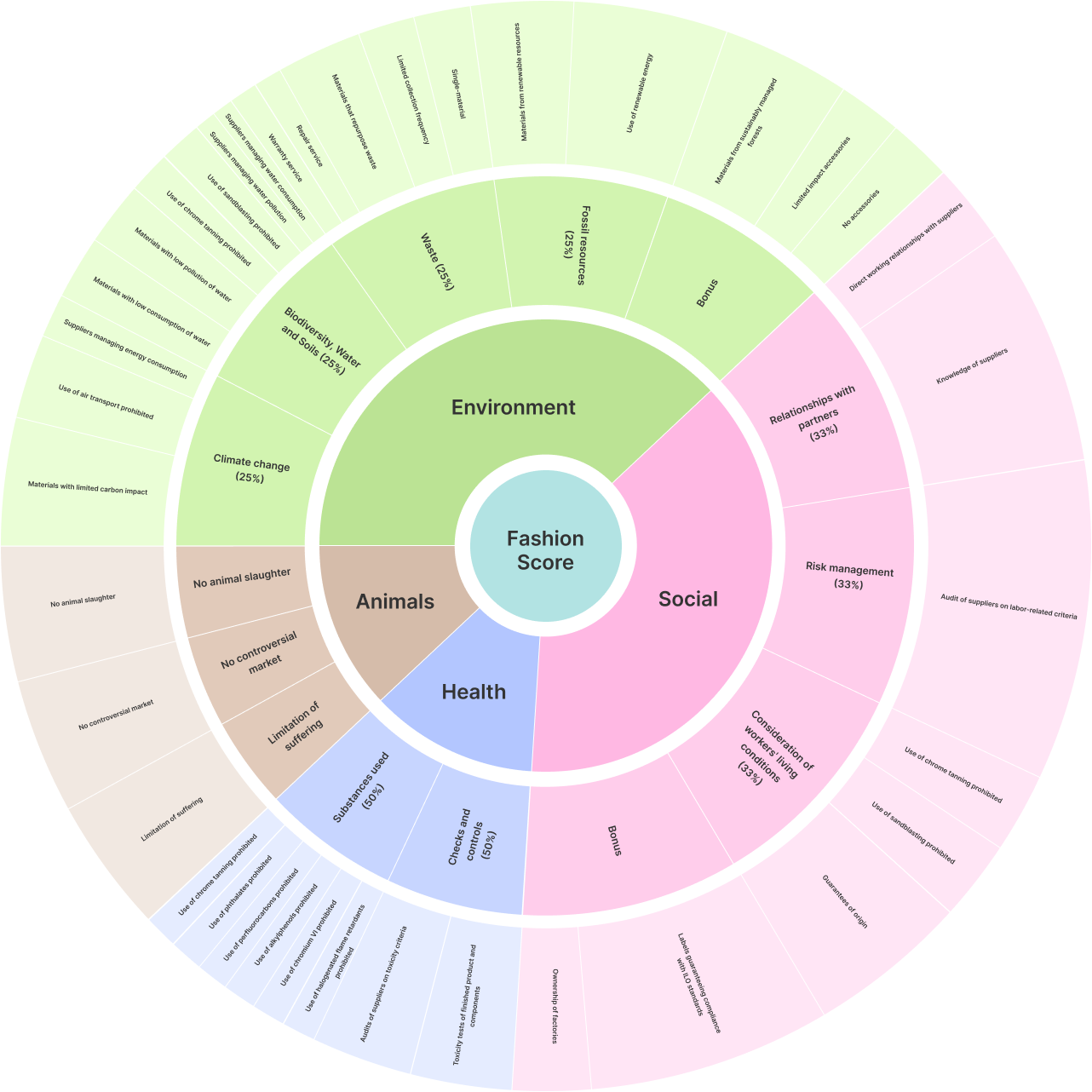
The Clear Fashion methodology assesses a brand’s practices and the impact of its products across 4 themes: Environment, Social, Health and Animals. It is built on a structured framework covering 14 impact categories, 32 sub-categories and more than 150 criteria.

4 analysis themes
150+ criteria
Social and environmental approach
Our method follows a clear chain: analysis framework, data collection, qualification and verification, calculation, then reporting.
Information is translated into usable answers, mapped to criteria, then aggregated through a weighted logic to produce a comparable and explainable reading.
Structured framework
Weighted calculation
Scientifically validated weighting
The method separates what feeds the calculation from what documents it. Labels, certificates, sources and supporting evidence serve to qualify answers, not to award points automatically. When information is not demonstrated, it is not credited.
Calculation and evidence kept separate
Documented qualification
No room for arbitrariness
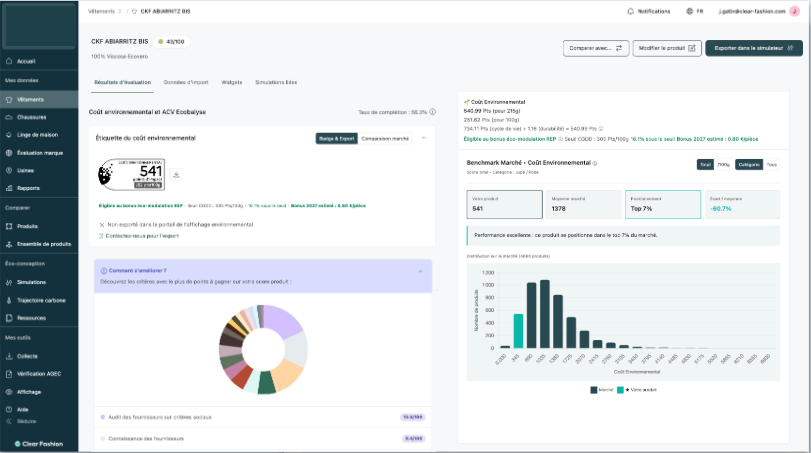
Results can be traced back to the answers, sources and rules involved. The method distinguishes performance, data completeness and the reliability of supporting evidence, in order to produce outputs that are clearer, more verifiable and more useful for decision-making.
Traceable, broken-down score
Explicit completion rate
Documented reasoning
Methodological governance
Industry frameworks
Clear Fashion goes beyond the results of a Life Cycle Assessment (LCA) alone. Our methodology calculates them and articulates them within a single, more complete framework, designed to produce a more coherent reading of practices, impacts and eco-design levers.

Details by Life Cycle stage
Built-in LCA-PEF limitations
Real, readable eco-design levers
Our method draws on a set of recognised databases, standards, publications and frameworks to analyse environmental, social, health and animal-material impacts.
LCA and PEF results
ILO & social risks
Labels, certifications, audits
This methodological framework produces results useful at several levels: sector calculations, eco-design, consumer-facing display, and preparation for the main regulatory frameworks.
Eco-design and sourcing
Consumer-facing display
Regulatory compatibility